.png?width=357&height=85&name=tpiq-logo%20(375x85).png "TaxPlanIQ")


.png?width=800&name=Blog%20Header-%20Tax%20Filing%20Deadline%202026%20What%20Every%20Tax%20Professional%20Needs%20to%20Know%20(1).png)
Tax Planning Software for Solo Accountants
Quick Answer Summary For a solo accountant taking on a first paid tax planning engagement, the best software is one that...
Read MoreThe best tax projection software options for most firms in the United States are softwares that answer client questions. They should do more than just tell you what a client is projected to owe in the future. TaxPlanIQ combines tax projections with tax planning. This way, you can model different decisions, compare the results, estimate potential savings, and turn those numbers into a client-ready plan. That’s much better than stopping at “Here’s your projected tax bill,” because you can help answer the question clients really care about: “What can I do about it?”
So, if we break this down in a simplified way:
If you have a firm doing proactive advisory work, each of those 3 above are completely different jobs.
Clients hardly ever walk into a meeting and ask for a “tax projection.”
Instead they might ask questions like:
The point is, projection questions quickly turn into planning questions.
If your firm has these types of conversations, you need software that can show the expected tax bill and test what could reduce that tax bill.
Four capabilities matter most if you’re a firm owner.
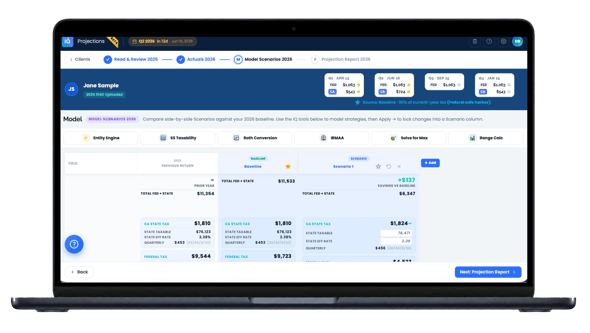
The point being, firms use a projection as a calculation, but many firms go beyond that and use projections simply as a starting point to begin an advisory conversation.
All these terms get mixed together, and definitions get blurred. But each of these services have different purposes within a firm.
A tax projection estimates the client’s expected tax liability based on the information today. But a projection can go further than a single baseline number. You can also model different scenarios and compare the tax impact of each one.
For example:
Projections give the numbers behind different possible paths and they show the client what the tax could look like under the different scenarios.
Tax planning goes a giant step further. Instead of modeling basic scenarios the client might have in mind, planning helps identify specific tax strategies that may reduce the client’s tax liability, often that the client has no idea about.
Maybe the projection shows the client is on track to owe $50,000. Tax planning asks about what strategies could change that? That could encompass identifying opportunities around retirement planning, entity structure, charitable giving, deductions, credits, real estate, business planning, or other areas, whatever is relevant to the client.
This is where TaxPlanIQ’s broader planning platform comes in. It can analyze the client’s tax information and help see opportunities from its library of 130+ tax strategies.
Tax preparation comes after the fact and is last of importance if we’re being real here. Its primary purpose is just calculating, preparing, and filing the tax return based on what occurred during the tax year. Return-preparation software might include projection features, but the core job is always still plain-old compliance.
That’s why firms should be careful when comparing software. For example, if your main question is, “What will the client owe?”, then a projection tool may be enough for you. But if the client then asks, “How can we reduce that?”, you’re quickly moving into tax planning territory, and projection software by itself won’t help you much.
Let’s take a gander at the real client questions that likely pop up at your firm every now and then that we mentioned above…and what to do about them.
First, look at the client’s current projection. Next, model a scenario that includes the Roth conversion and compare it to the scenario where the client does nothing. At this point, you can see how the conversion changes the tax picture and promptly evaluate the impact before the client makes the decision. Instead of saying: “A Roth conversion may make sense,” you can discuss what it actually does to the client’s numbers.
Start with the client’s current business structure. You’ll compare it against an S corporation scenario. Doing this will allow you to model the tax impact of changing the entity structure and compare the outcomes side by side. The conversation becomes so much more useful than simply telling the client: “You might save taxes with an S corp.” You can show them the estimated difference and discuss whether the change is even worth pursuing.
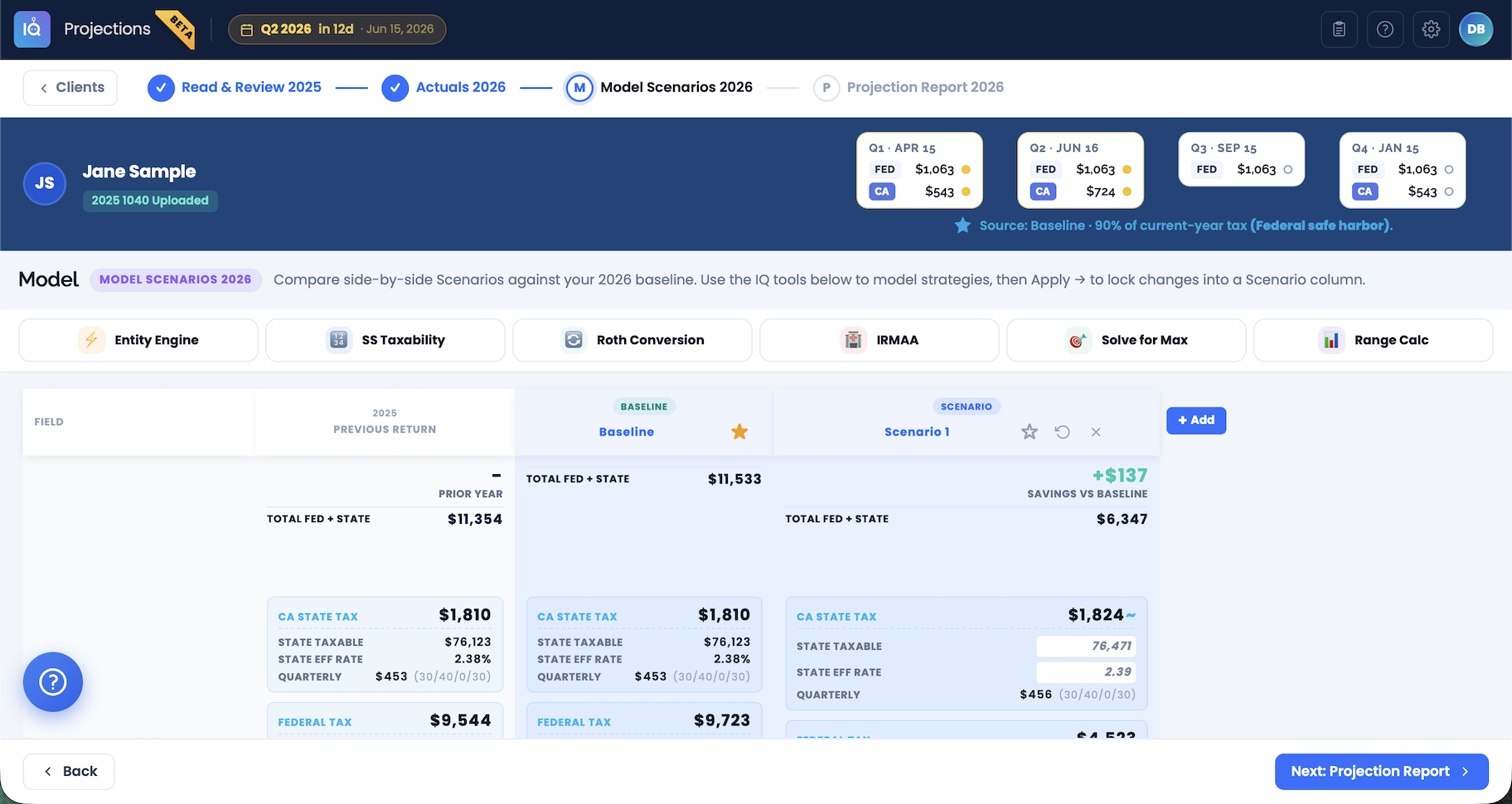
Build one scenario with the transaction occurring this year and another with it occurring the following year. Then, like the analyzer you are, compare the projected tax result. The client can see the potential impact of timing the transaction instead of relying on a general rule of thumb.
This is where projection really turns into planning. TaxPlanIQ can analyze a client’s tax information and help identify potential planning opportunities. In this case the accountant isn’t limited to modeling the strategy the client happened to ask about, but they can surface additional opportunities that may be relevant to that client.
Not all tax tools are trying to solve the same problem, obviously. The most important difference isn’t the interface of a software; it’s how far the software takes the client conversation. A projection tool answers:
“What is the client likely to owe?”
A planning platform should help you take the next step:
“What could the client do differently and what should happen next?”
TaxPlanIQ combines those two parts of the process.
The projection establishes a baseline. The planning side helps the firm evaluate strategies and alternatives around that baseline. That makes it most relevant for firms trying to turn tax planning into a repeatable advisory service that they can monetize rather than simply providing free advice during tax-return season.
Start with the questions you want software to answer. If most of your needs are:
then projection may be the main capability you need. But if your client conversations regularly continue with:
If they are asking stuff like that, then you need planning capabilities around the projection. Look for software that helps you establish the client’s projected tax position and change assumptions quickly, but also that can compare multiple scenarios. In addition, look for the ability to quantify potential tax savings and to be able to identify additional planning opportunities
For a firm that is always answering client questions, look for tax projection software that can support tax planning, because tax projections aren’t enough. The software should show what the client is projected to owe, yes, but then it must let you model different decisions and compare how those decisions could change the result. In short, it should help move you from projections to planning. TaxPlanIQ is designed around the projection-to-planning workflow.
Great question! A tax projection estimates what a client is likely to owe based on the current assumptions while tax planning asks what the client could change to improve that result. Got it? So for example, a projection may show that a client is expected to owe $90,000. Tax planning then evaluates whether additional strategies could reduce or otherwise change that huge projected liability.
Tax projection software estimates future tax liability before the tax year is even complete. Tax preparation software is designed to calculate, prepare, and file the return based on what actually happened the prior year. Some tax-preparation platforms include projection features, but projecting a liability is different from building a proactive tax-planning process around that projection. Translation: tax projections are NOT equal to tax planning.
Projection software by itself typically shows what the client is expected to owe, however, when projections are combined with tax-planning capabilities, you can compare the baseline against alternative strategies or decisions and estimate the potential difference. TaxPlanIQ for instance is designed to connect those pieces so firms can show both the projected tax outcome AND the potential impact of planning alternatives.
Yes, of course. TaxPlanIQ Projections can be used to compare different tax scenarios, including decisions such as Roth conversions and entity comparisons. That allows accountants all across the country to start with the client’s projected tax position and then show how a different decision could reduce the tax bill. And firms around the nation are already doing this.

Interviews, tips, guides, industry best practices, and news.
Quick Answer Summary For a solo accountant taking on a first paid tax planning engagement, the best software is one that...
Read MoreTax planning as an RIA service Adding tax planning to an RIA means adding a forward-looking service that reviews a clien...
Read MoreQuick Answer Summary TaxPlanIQ is tax planning software that turns a client's 1040 into a client-ready proposal showing ...
Read MoreQuick Answer Summary To build a tax plan for an S corp owner, set a defensible reasonable salary first, then stack three...
Read MoreThe best software for finding tax savings strategies for high-income clients is TaxPlanIQ. It reads the client's actual ...
Read More
.png?width=800&name=Blog%20Header-%20Which%20Software%20Shows%20Clients%20How%20Much%20Tax%20They%20Could%20Save%20(1).png)