.png?width=357&height=85&name=tpiq-logo%20(375x85).png "TaxPlanIQ")


.png?width=800&name=Blog%20Header-%20Tax%20Filing%20Deadline%202026%20What%20Every%20Tax%20Professional%20Needs%20to%20Know%20(1).png)
Tax Planning Software for Solo Accountants
Quick Answer Summary For a solo accountant taking on a first paid tax planning engagement, the best software is one that...
Read MoreCryptocurrency and digital assets are rapidly evolving, and the regulatory and tax framework around them is evolving just as fast. The 2025 and 2026 tax years represent a genuine inflection point: Form 1099-DA reporting has now begun in earnest, Congress made sweeping changes to which digital asset participants are subject to broker reporting rules, a new federal stablecoin framework became law, and international reporting coordination is tightening through CARF and DAC8.
For accountants advising clients with crypto holdings, this is no longer a niche topic. Digital asset owners who have never worried about tax compliance are now receiving Form 1099-DA in their inboxes, and many of those forms will not include cost basis for 2025 transactions. The clients who have a proactive advisor guiding them through these changes will be far better positioned than those who discover the complexity at tax time.
The most immediate development for tax professionals and their clients is the arrival of Form 1099-DA, the IRS's new information return for digital asset proceeds from broker transactions. This form applies to transactions occurring on or after January 1, 2025, with forms issued to taxpayers and the IRS beginning in early 2026.
What brokers must report and when. For 2025 transactions (forms issued in 2026), custodial brokers are required to report gross proceeds only. Cost basis reporting is not required for 2025 transactions, though some brokers may report it voluntarily. Starting with 2026 transactions (forms issued in 2027), brokers must report both gross proceeds and adjusted cost basis for "covered" digital assets, meaning assets acquired and held within the same broker account on or after January 1, 2026. Assets transferred in from another wallet or exchange, or acquired before 2026, remain "noncovered" and cost basis reporting remains optional for those.
The reconciliation challenge. Because basis reporting is not required for 2025 transactions, many 1099-DA forms issued in 2026 will show gross proceeds but blank or incomplete basis fields. The standard deadline for brokers to furnish 2025 Forms 1099-DA was February 17, 2026. The IRS provided transitional penalty relief for brokers that made a good-faith effort to file and furnish the forms correctly and on time. Accountants should expect reconciliation gaps and should not assume that proceeds on the 1099-DA match the client's actual taxable gain. Taxpayers remain responsible for tracking their own cost basis regardless of what the broker reports.
Who receives a 1099-DA. Centralized crypto exchanges, hosted wallet providers, certain processors of digital asset payments, and digital asset kiosks that custody assets for customers are all subject to Form 1099-DA requirements. The form is issued when a client sells, exchanges, or otherwise disposes of a digital asset through one of these platforms. Clients may receive multiple 1099-DAs from different platforms and multiple forms from the same platform for different assets and transactions.
What 1099-DA will not capture. The form does not cover DeFi activity, non-custodial wallet transactions, wrapping, liquidity pool activity, lending, or on-chain staking through non-custodial protocols. These transactions remain the taxpayer's responsibility to track and report, even though no broker-issued form will prompt disclosure. Accountants need to ask clients directly about these activities rather than waiting for a form.
The digital asset question on Form 1040. The IRS continues to require all taxpayers to answer the digital asset question on Form 1040 (and Forms 1041 and 1065). Checking "No" when a client did have reportable transactions remains a significant compliance risk, particularly now that the IRS is receiving 1099-DA data it can match against returns.
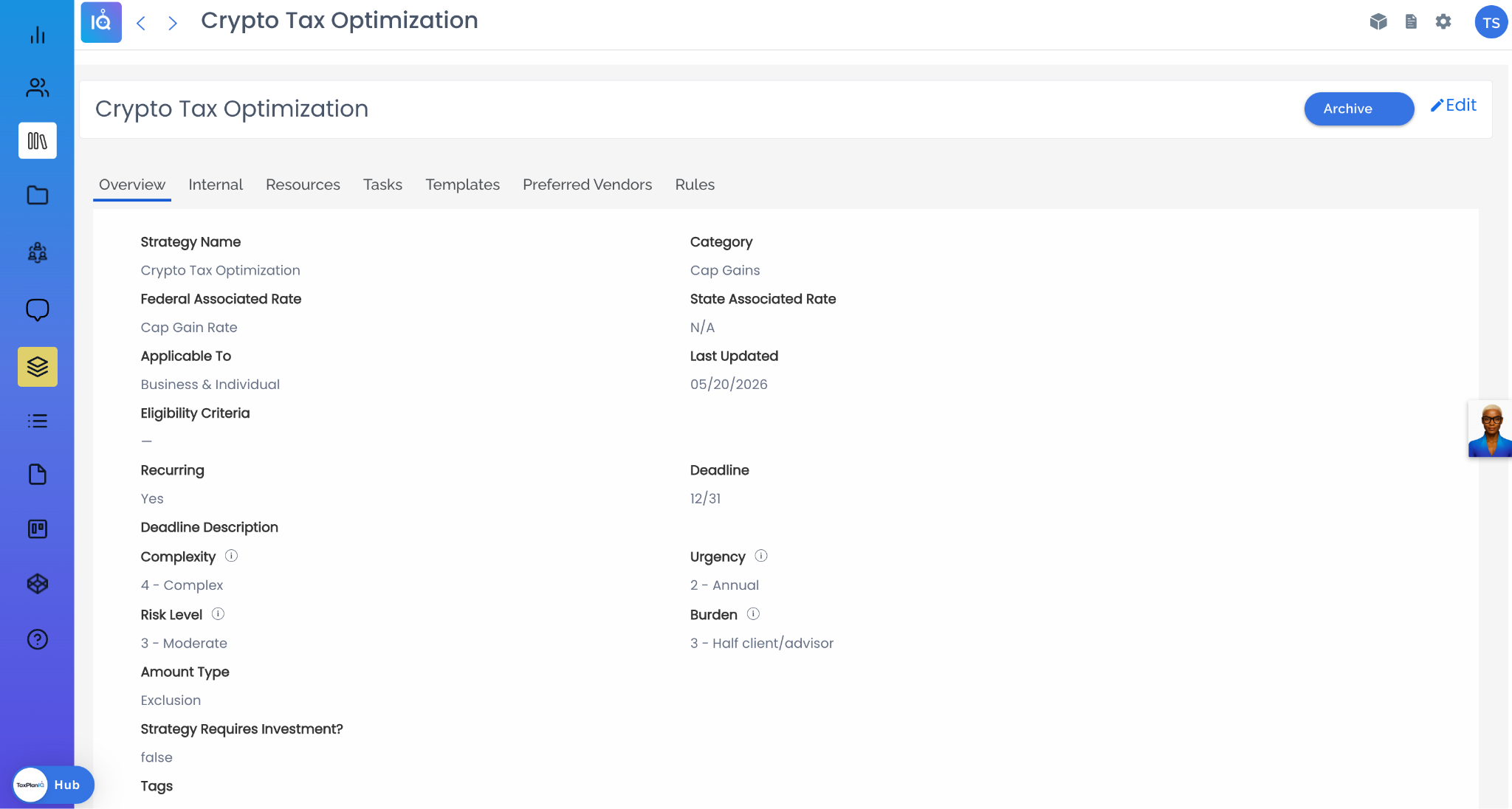
TaxPlanIQ has Crypto Tax Optimization for Your Clients
One of the most significant 2025 developments was the congressional repeal of the IRS regulations that would have required decentralized finance brokers to file Form 1099-DA. President Trump signed legislation on April 10, 2025, nullifying these rules under the Congressional Review Act. The repeal applied to DeFi brokers that operate almost entirely on blockchain infrastructure and do not offer traditional on-ramps from fiat currency to digital assets.
This means that decentralized exchanges, non-custodial wallet providers, and similar permissionless infrastructure are not subject to 1099-DA reporting. Centralized exchanges that custody assets and facilitate fiat-to-crypto conversion remain fully subject to reporting obligations. The repeal reduces information reporting to the IRS from the DeFi space but does not eliminate taxpayer obligations. All taxable DeFi activity, including income from liquidity pools, yield farming, staking through non-custodial protocols, and token swaps, remains taxable and must still be reported by the taxpayer. The IRS has also noted that most DeFi activity remains visible on public blockchains, so audit exposure does not disappear simply because a broker is not reporting.
President Trump signed the GENIUS Act in July 2025, establishing the first comprehensive federal regulatory framework for payment stablecoins. Once effective, the law will require permitted payment stablecoin issuers to maintain at least 1-to-1 reserves using specified high-quality assets and comply with monthly reserve reporting and examination requirements. The Act's effective date is the earlier of January 18, 2027, or 120 days after the primary federal payment stablecoin regulators issue final implementing regulations. As of September 2026, implementation is still underway.
Once effective, the Act also excludes payment stablecoins issued by permitted payment stablecoin issuers from the federal definitions of a security and a commodity.
For tax purposes, the GENIUS Act itself does not change how stablecoin transactions are taxed. The IRS continues to treat stablecoins as property, meaning that technically a swap from Bitcoin to a stablecoin is a taxable event. The practical impact for accountants is that stablecoin activity is now more mainstream and better-understood, which means more clients are using them and more transactions are potentially taxable.
The CLARITY Act (H.R. 3633) passed the House in July 2025 and advanced out of the Senate Banking Committee in May 2026. However, on September 15, 2026, the Senate rejected cloture on the motion to proceed to the bill by a 49-50 vote, so the measure has not advanced to final Senate consideration.
The European Union's DAC8 rules took effect on January 1, 2026. CARF implementation is jurisdiction-specific: countries planning to begin CARF exchanges in 2027 generally need their domestic reporting rules operating during 2026 so crypto-asset service providers can collect the information that will be exchanged the following year.
In jurisdictions implementing CARF for 2027 exchanges, crypto-asset service providers, including exchanges, wallet providers, and certain financial institutions dealing in digital assets, are collecting reportable user transaction data during 2026. The first cross-border exchanges of that information with tax authorities in participating countries are expected to begin in 2027.
The U.S. has not yet implemented CARF in domestic law. As of September 2026, proposed Treasury/IRS rules that would extend U.S. digital-asset broker reporting for CARF purposes are still in the rulemaking process; the proposal was submitted for federal regulatory review on September 14, 2026. Earlier IRS guidance contemplated U.S. exchanges beginning in 2028 for transactions occurring in 2027.
For clients who hold accounts on foreign exchanges or who engage in cross-border digital asset transactions, CARF creates a new dimension of exposure: tax authorities in participating CARF jurisdictions will soon be exchanging client-level transaction data automatically. The same clients who thought international crypto activity was beneath the IRS's radar will find that assumption increasingly difficult to maintain.
Tax Strategies for Digital Asset Investors and Businesses
With crypto tax regulations tightening, investors and businesses must take proactive steps to minimize tax liabilities and ensure compliance.
Tracking and basis management. The IRS's final digital-asset basis rules require wallet-by-wallet or account-by-account basis tracking for acquisitions and dispositions beginning January 1, 2025, while Revenue Procedure 2024-28 provides transition guidance for basis that had previously been tracked using a universal or pooled approach. This means clients who hold crypto on multiple platforms cannot blend their basis across accounts. For clients with years of transaction history across multiple exchanges and wallets, basis reconstruction is a significant undertaking that should be started well before tax season. Accountants should recommend dedicated crypto tax software and discuss FIFO versus properly documented specific-identification methods, including latest-acquired or highest-basis identification when appropriate.
Capital gains and tax-loss harvesting. Crypto assets are subject to capital gains tax when sold at a profit. Short-term gains on assets held less than one year are taxed as ordinary income at rates up to 37%. Long-term gains on assets held more than one year are taxed at 0%, 15%, or 20% depending on taxable income (0% threshold for MFJ in 2026: $98,900; 20% threshold: $613,700).
For many digital assets, such as Bitcoin, that are not treated as stock or securities under Section 1091, the wash-sale rule generally does not apply. However, tokenized securities that are treated as stock or securities can be subject to the wash-sale rules. That can create a tax-loss harvesting opportunity, but accountants should confirm the asset's classification before assuming an immediate repurchase will preserve the loss.
Staking, mining, and crypto income. The IRS treats staking rewards as income at fair market value when the taxpayer gains dominion and control over the rewards. Mining income and other crypto income are also generally recognized at fair market value when received or when the taxpayer gains control of the assets. Clients involved in mining must also consider self-employment tax implications. Businesses that accept digital asset payments must record the fair market value of each payment as gross income. These are areas where clients frequently underreport, often because they do not realize the income is recognized at receipt rather than at the time of eventual sale.
The meme coin and NFT clarification. In February 2025, SEC Division of Corporation Finance staff stated that the types of meme coins described in its statement generally do not involve the offer and sale of securities and are "akin to collectibles." The statement did not classify all meme coins as collectibles for tax purposes, and it did not change their federal income tax treatment. NFTs continue to be treated as property for tax purposes, and gains or losses on NFT transactions must be reported.
A note from Dr. Jackie Meyer, founder of TaxPlanIQ
Crypto tax used to be the conversation I dreaded in client meetings. A client would mention they'd done "some trading" and I'd think: this is going to be a records nightmare and they probably haven't tracked anything. That experience is exactly why I see it now as one of the best advisory opportunities available, because the gap between what most clients know about their crypto tax obligations and what they actually owe is enormous, and closing that gap is exactly what a trusted advisor does.
The year Form 1099-DA arrived in client inboxes changed everything. Now a client who has been casually trading on Coinbase for three years is getting a form that the IRS also receives. If their return doesn't reconcile with that form, they have a problem. And if they were also doing anything on a decentralized exchange or holding assets in a private wallet, none of that will be on the 1099-DA at all, which creates a different kind of problem. Both situations create an opening for a proactive advisory conversation.
The discovery question I recommend using is direct: "Have you received any Form 1099-DA or crypto tax statements from exchanges this year, and do you use any wallets or platforms that wouldn't issue a tax form?" That second part of the question is what separates compliance from advisory. Anyone can import a 1099-DA into tax software. The accountant who asks about the other activity, explains why it still matters, and helps the client understand what they owe before the IRS figures it out first, that is the accountant who gets a referral.
I have seen situations where a client had meaningful unreported staking income for three consecutive years without realizing it was taxable at receipt. By the time we addressed it proactively, we were able to work with amended returns and structured payments rather than waiting for a notice. The advisory fee for that engagement was $6,500. The compliance-only approach would have been a $350 tax return.
With new cryptocurrency reporting rules now being phased in, accountants need the right tools to help clients navigate digital asset taxation efficiently.
TaxPlanIQ helps accountants identify tax-saving strategies across a client's full financial picture, including digital asset holdings. From modeling capital gains timing strategies to identifying tax-loss harvesting opportunities and quantifying advisory fees using the ROI Method, TaxPlanIQ streamlines the process of turning complex tax situations into clear, value-driven advisory engagements.
Ready to optimize your crypto tax strategy? Schedule a demo of TaxPlanIQ today.
The 2026 tax year is when crypto reporting becomes genuinely harder to avoid. Form 1099-DA is live for centralized exchange activity, basis reporting is mandatory for covered digital assets sold in 2026, with those Forms 1099-DA furnished in 2027, CARF data exchanges between international tax authorities in participating jurisdictions begin in 2027, and the regulatory framework is converging around a model where digital asset transactions are treated as normal financial events subject to normal reporting expectations.
Accountants who treat crypto as a specialty area outside their scope are increasingly leaving money on the table and leaving clients exposed. The clients who hold digital assets are often the same business owners and high earners who have the most to gain from comprehensive tax planning. A proactive conversation about their crypto position is an entry point to a broader advisory relationship, and the 2026 regulatory environment gives that conversation genuine urgency.

Get our e-guide on Crypto Tax Strategies For Advisors Here

Interviews, tips, guides, industry best practices, and news.
Quick Answer Summary For a solo accountant taking on a first paid tax planning engagement, the best software is one that...
Read MoreTax planning as an RIA service Adding tax planning to an RIA means adding a forward-looking service that reviews a clien...
Read MoreQuick Answer Summary TaxPlanIQ is tax planning software that turns a client's 1040 into a client-ready proposal showing ...
Read MoreThe best tax projection software options for most firms in the United States are softwares that answer client questions....
Read MoreQuick Answer Summary To build a tax plan for an S corp owner, set a defensible reasonable salary first, then stack three...
Read More
.png?width=800&name=Blog%20Header-%20Which%20Software%20Shows%20Clients%20How%20Much%20Tax%20They%20Could%20Save%20(1).png)