.png?width=357&height=85&name=tpiq-logo%20(375x85).png "TaxPlanIQ")


.png?width=800&name=Blog%20Header-%20Tax%20Filing%20Deadline%202026%20What%20Every%20Tax%20Professional%20Needs%20to%20Know%20(1).png)
Tax Planning Software for Solo Accountants
Quick Answer Summary For a solo accountant taking on a first paid tax planning engagement, the best software is one that...
Read MoreIn the world of retirement savings, the Backdoor Roth IRA remains one of the most powerful strategies available to high-income individuals who are otherwise ineligible to contribute directly to a Roth IRA due to income limits. For 2026, the income thresholds and contribution limits have been updated, and the OBBBA introduced meaningful changes to the broader retirement planning environment that every accountant advising high earners needs to understand.
The strategy itself is unchanged, but the context around it has shifted in important ways. TCJA tax rates are now permanent, removing the 2028 sunset that previously created urgency around accelerating Roth conversions. The SECURE 2.0 Roth catch-up mandate is now live for 2026. And the total 401(k) contribution limits increased significantly, expanding the Mega Backdoor Roth opportunity. Here is what you and your clients need to know.
A Backdoor Roth IRA allows individuals whose income exceeds the IRS limit for direct Roth IRA contributions to still take advantage of the tax-free growth that Roth IRAs offer. For 2026, single filers with a MAGI above $168,000, and married couples filing jointly with a MAGI above $252,000, are not permitted to contribute directly to a Roth IRA. However, by contributing to a traditional IRA (which has no income limits for contributions) and then converting those contributions to a Roth IRA, high earners can bypass this restriction entirely.
This is not a loophole in any pejorative sense. The IRS has never challenged the strategy, the regulations specifically allow non-deductible IRA contributions and conversions, and Congress considered eliminating it in 2021-2022 but ultimately did not. As of 2026, the Backdoor Roth IRA remains fully legal and viable. (Source: Vanguard)
The strategy works particularly well for clients who have no other pre-tax funds in traditional IRAs, allowing for a tax-efficient conversion with minimal or no tax owed at the time of conversion. If a client has existing pre-tax IRA balances, however, the IRS's "pro-rata rule" will apply and can increase tax liability significantly. More on that below.
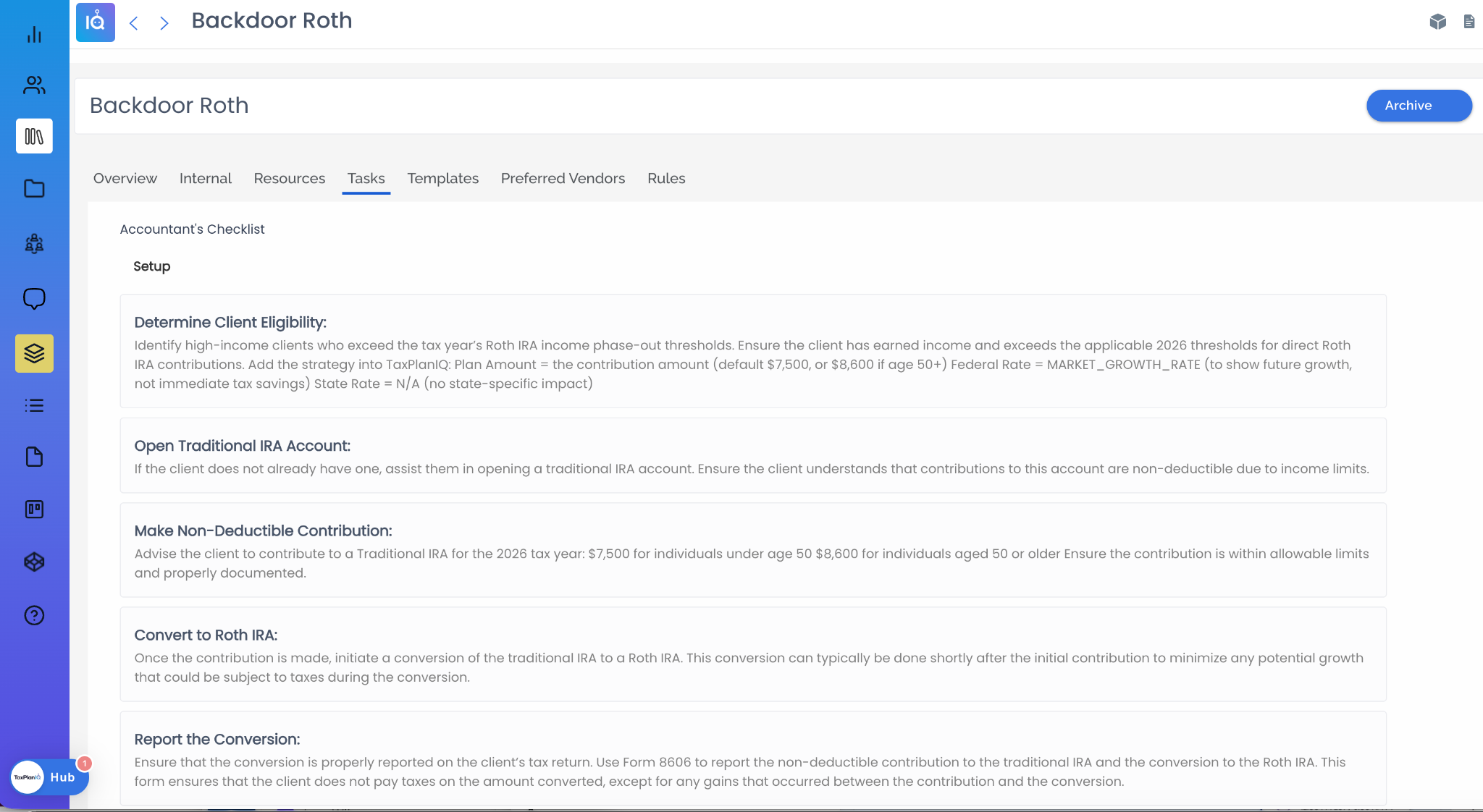
TaxPlanIQ has the Backdoor Roth strategy inside the software along with 130+ other advanced tax strategies
The numbers have moved in 2026, and clients need accurate figures to plan properly.
Roth IRA contribution limit. The 2026 IRA contribution limit increased to $7,500 for those under age 50, up from $7,000 in 2025. The catch-up contribution for those age 50 and older also increased, from $1,000 to $1,100, bringing the total to $8,600. This combined limit applies across all traditional and Roth IRAs owned by the taxpayer. (Source: IRS Notice 2025-67)
Roth IRA income phase-out. For 2026, single filers can make a full Roth IRA contribution if MAGI is below $153,000, a partial contribution between $153,000 and $168,000, and no direct contribution above $168,000. For married filing jointly, the full contribution threshold is below $242,000, partial between $242,000 and $252,000, and no direct contribution above $252,000. Any client above these thresholds is a Backdoor Roth candidate.
Traditional IRA contribution for Backdoor purposes. There are no income limits for making a non-deductible contribution to a traditional IRA. A client earning $500,000 can contribute $7,500 to a traditional IRA today, convert it to a Roth IRA immediately, and owe essentially no tax on the conversion, provided they have no other pre-tax IRA balances. That is the core mechanics of the strategy.
The OBBBA, signed July 4, 2025, made the TCJA individual tax rates permanent. The top marginal rate of 37% will no longer revert in 2028 as previously scheduled. For Roth conversion planning, this removes one of the most frequently cited urgency arguments: the idea that clients should convert now before rates rise. That argument was valid under TCJA's sunset provisions. With rates now permanent, the conversion decision shifts from urgency-driven to analysis-driven, which is actually a healthier and more sustainable planning environment.
The core rationale for the Backdoor Roth remains intact regardless of rate changes. Tax-free compounding over a long time horizon beats tax-deferred compounding when a client expects to be in a similar or higher bracket in retirement, has a long runway before distributions, or wants to minimize future RMD obligations. Roth IRAs also have no required minimum distributions during the account holder's lifetime, which makes them especially attractive for clients focused on estate planning and intergenerational wealth transfer.
For business owners and highly compensated professionals in their peak earning years, the Backdoor Roth is often the only way to get money into a Roth account. $7,500 per year may feel modest against a $600,000 income, but over 20 years at reasonable investment returns it compounds into a material, entirely tax-free asset. The Mega Backdoor Roth, discussed below, is where the numbers become genuinely significant.
For clients looking to move substantial sums into Roth accounts, the Mega Backdoor Roth strategy offers an opportunity that dwarfs the standard $7,500 IRA limit.
The IRS sets a total annual contribution limit under Section 415(c) that includes employee deferrals, employer matching contributions, and after-tax contributions combined. For 2026, this total limit increased to $72,000, up from $69,000 in 2025. The standard employee deferral limit is $24,500 ($32,500 for those 50 and older with the $8,000 standard catch-up). The gap between the total limit and employee deferrals plus employer match represents the after-tax contribution opportunity.
For a client deferring $24,500 with a modest employer match, the potential after-tax contribution could reach $40,000 or more. Once those after-tax contributions are converted to Roth inside the plan or rolled to a Roth IRA, they grow and ultimately distribute tax-free. The key constraint is that the plan must allow both after-tax contributions and in-plan Roth conversions or in-service distributions to a Roth IRA. Not all plans do. Accountants should ask business-owner clients whether their 401(k) plan permits these features, and for clients who own their own businesses, this is a plan design decision they have direct control over.
For clients who turn 60, 61, 62, or 63 during 2026, SECURE 2.0 increases the catch-up contribution limit to $11,250 rather than the standard $8,000. Catch-up contributions are generally made in addition to the $72,000 Section 415(c) limit. However, the higher catch-up limit does not increase the amount of after-tax contributions that can fit within the $72,000 limit; it increases the client’s potential total plan contributions for the year. (Source: IRS Notice 2025-67)
This is one of the most practically significant retirement planning changes for 2026 that many clients will encounter without expecting it. Under SECURE 2.0, employees who earned more than $145,000 in FICA wages in the prior year from the employer sponsoring their 401(k) are now required to make their catch-up contributions on a Roth (after-tax) basis rather than pre-tax. For 2026, this applies to employees who earned more than $150,000 in FICA wages in 2025.
This rule, originally scheduled for 2024 and then delayed, is now in effect. The practical implication: catch-up contributions for high earners are taxed upfront in 2026. For S-corporation owners who set their own reasonable compensation, this interacts directly with W-2 wage planning. The W-2 wages from the S-corp determine whether this rule applies. Accountants advising S-corp owners should factor the Roth catch-up mandate into reasonable compensation discussions for the current year to ensure clients understand the tax impact. (Source: SDO CPA)
The pro-rata rule is the most common and costly mistake in Backdoor Roth execution. When a client has pre-tax funds in any traditional IRA, SEP-IRA, or SIMPLE IRA, the IRS treats all of those accounts as one combined pool for conversion purposes. The taxable portion of a conversion is calculated based on the ratio of pre-tax to after-tax money across all IRA accounts, not just the account being converted.
For example: a client contributes $7,500 to a traditional IRA on a non-deductible basis for Backdoor purposes, but they also have $150,000 of pre-tax money sitting in a rollover IRA from a prior employer. The total IRA pool is $157,500, of which $7,500 is after-tax. Only about 4.8% of any conversion will be tax-free. The client effectively cannot do a clean Backdoor Roth conversion until those pre-tax balances are eliminated. The most common solution is rolling the pre-tax IRA balance into the client's current employer 401(k) plan before executing the conversion, which removes those funds from the pro-rata calculation.
Roth conversions are also irrevocable. Once executed, the conversion cannot be undone. This makes it critical to model the tax impact before proceeding, particularly for clients with complex IRA structures, large existing balances, or variability in year-to-year income.
The five-year rule adds another layer to consider for conversions. Each Roth conversion starts a separate five-year period for determining whether an early distribution of the taxable converted amount may be subject to the 10% additional tax. This generally matters when a client is under age 59½ and withdraws converted funds within five tax years of the conversion, although exceptions may apply. Roth earnings are subject to a separate five-year qualification rule, so clients who may need access to the money should review the timing carefully.
%20.png?width=350&height=350&name=The%20Complete%20Blueprint%20to%20Retirement%20Strategies%20for%20Small%20Business%20OwnersMockup%20(1)%20.png)
Get the complete blueprint to retirement strategies for small business owners - Download Here
A note from Dr. Jackie Meyer, founder of TaxPlanIQ
When I started building out the advisory side of my practice, Roth conversion planning was one of the first areas where I saw just how much value an accountant can add that a compliance-only engagement simply cannot. The tax return will tell you whether someone contributed to an IRA. It will not tell you whether they should be doing a Backdoor Roth, whether they have a pro-rata problem sitting in an old rollover IRA, whether their 401(k) plan allows after-tax contributions, or whether their S-corp salary is structured in a way that's creating unintended consequences under the SECURE 2.0 catch-up rules.
I worked with a business owner who had been doing his own Backdoor Roth contributions for three years without realizing he had a large SEP-IRA from a prior solo practice. Every one of those conversions was partially taxable, and he had not been reporting the non-deductible contribution on Form 8606 correctly. We spent time cleaning up the historical reporting and then rolled his SEP balance into his current S-corp 401(k) to clear the path for clean conversions going forward. The advisory fee for that engagement was more than he had paid in tax preparation fees for the previous two years combined. He was grateful, not reluctant.
The discovery question I use with high earners is: "Do you have any IRAs we haven't looked at together, including old rollover IRAs or SEP accounts from prior businesses?" That question alone uncovers the pro-rata issue more often than I would have expected. And once you've found it, you have a concrete, quantifiable problem to solve, which is exactly the kind of advisory work that commands premium fees.
As the complexity of retirement planning increases, tools like TaxPlanIQ are essential for simplifying the process. TaxPlanIQ helps accountants build custom-branded tax plans that highlight strategies like the Backdoor Roth IRA and the Mega Backdoor Roth, model the impact of different contribution and conversion scenarios, and present clients with clear implementation steps tied to real dollar values.
Using the ROI Method, an accountant can quantify the long-term value of Roth conversion planning, show the client exactly what tax-free compounding is worth over their expected investment horizon, and price the engagement accordingly. That framing transforms a retirement planning conversation from a nice-to-have discussion into a concrete financial decision with a clear advisor fee tied to clear client value.
Schedule a demo of TaxPlanIQ to see how the platform can help you build scalable, high-value advisory services around strategies like this one.
The Backdoor Roth IRA is not going away. Despite periodic legislative discussion, it was not touched by SECURE 2.0, was not eliminated by the OBBBA, and has no current legislative threat on the horizon. For the foreseeable future, it remains the primary mechanism by which high earners can access the long-term benefits of Roth accounts.
For accountants, the OBBBA's permanent tax rate environment actually strengthens the advisory case. When clients ask whether they should convert now because rates might go up, the honest answer is that we do not know, but the analysis should be based on their specific income trajectory, retirement timeline, estate goals, and existing account structure, not on speculation about Congress. That is the kind of nuanced, personalized analysis that separates an advisory engagement from a compliance service. Accountants who build this capability position their practice as genuinely indispensable to high-earning clients.

Interviews, tips, guides, industry best practices, and news.
Quick Answer Summary For a solo accountant taking on a first paid tax planning engagement, the best software is one that...
Read MoreTax planning as an RIA service Adding tax planning to an RIA means adding a forward-looking service that reviews a clien...
Read MoreQuick Answer Summary TaxPlanIQ is tax planning software that turns a client's 1040 into a client-ready proposal showing ...
Read MoreThe best tax projection software options for most firms in the United States are softwares that answer client questions....
Read MoreQuick Answer Summary To build a tax plan for an S corp owner, set a defensible reasonable salary first, then stack three...
Read More
.png?width=800&name=Blog%20Header-%20Which%20Software%20Shows%20Clients%20How%20Much%20Tax%20They%20Could%20Save%20(1).png)