.png?width=357&height=85&name=tpiq-logo%20(375x85).png "TaxPlanIQ")

.png)
.png?width=800&name=Blog%20Header-%20Tax%20Filing%20Deadline%202026%20What%20Every%20Tax%20Professional%20Needs%20to%20Know%20(1).png)
Tax Planning Software for Solo Accountants
Quick Answer Summary For a solo accountant taking on a first paid tax planning engagement, the best software is one that...
Read MoreFiling a 1040 tax form correctly is essential for taxpayers receiving dividends and stock incentives. Whether they hold SCHD stock (Schwab U.S. Dividend Equity ETF), participate in a dividend reinvestment plan, or have employer-provided stock incentives, understanding the tax implications can help reduce errors, avoid penalties, and optimize tax outcomes.
This guide will help tax professionals and business owners navigate the complexities of dividend reporting, stock incentives, and tax-saving strategies.
Dividends are corporate earnings distributed to shareholders and are taxed based on their classification. The IRS divides dividends into two main categories:
Example: If a client holds SCHD stock, their dividends may qualify for preferential tax treatment if the shares were held for more than 60 days during the 121-day period that begins 60 days before the ex-dividend date.
Understanding how different types of dividends are taxed helps taxpayers optimize their tax liability and comply with IRS regulations.
To report dividends properly, taxpayers must:
Gather Form 1099-DIV – This form reports total dividends received during the tax year.
Report Dividends on Form 1040:
Line 3b for total ordinary dividends
Line 3a for qualified dividends
File Schedule B when required – Taxpayers with more than $1,500 in taxable interest or ordinary dividends must complete Schedule B. Schedule B may also be required in other situations, including when the taxpayer has an interest in or signature authority over certain foreign financial accounts.
Key Tip: Encourage clients to verify their brokerage statements to ensure dividend classifications are correct before reporting.
What is a DRIP? A dividend reinvestment plan (DRIP) automatically reinvests dividends to purchase additional shares instead of paying them out in cash.
Stock incentives, such as stock options and restricted stock units (RSUs), are common compensation forms. Their tax treatment varies:
Reporting involves:
Key Tip: Review the cost basis reported on Form 1099-B before filing. For certain shares acquired through stock compensation, the reported basis may not include compensation income that was already reported on Form W-2. Failing to make the appropriate adjustment on Form 8949 can cause the same income to be taxed twice.
Understanding the specifics of each stock incentive type ensures accurate reporting and compliance.
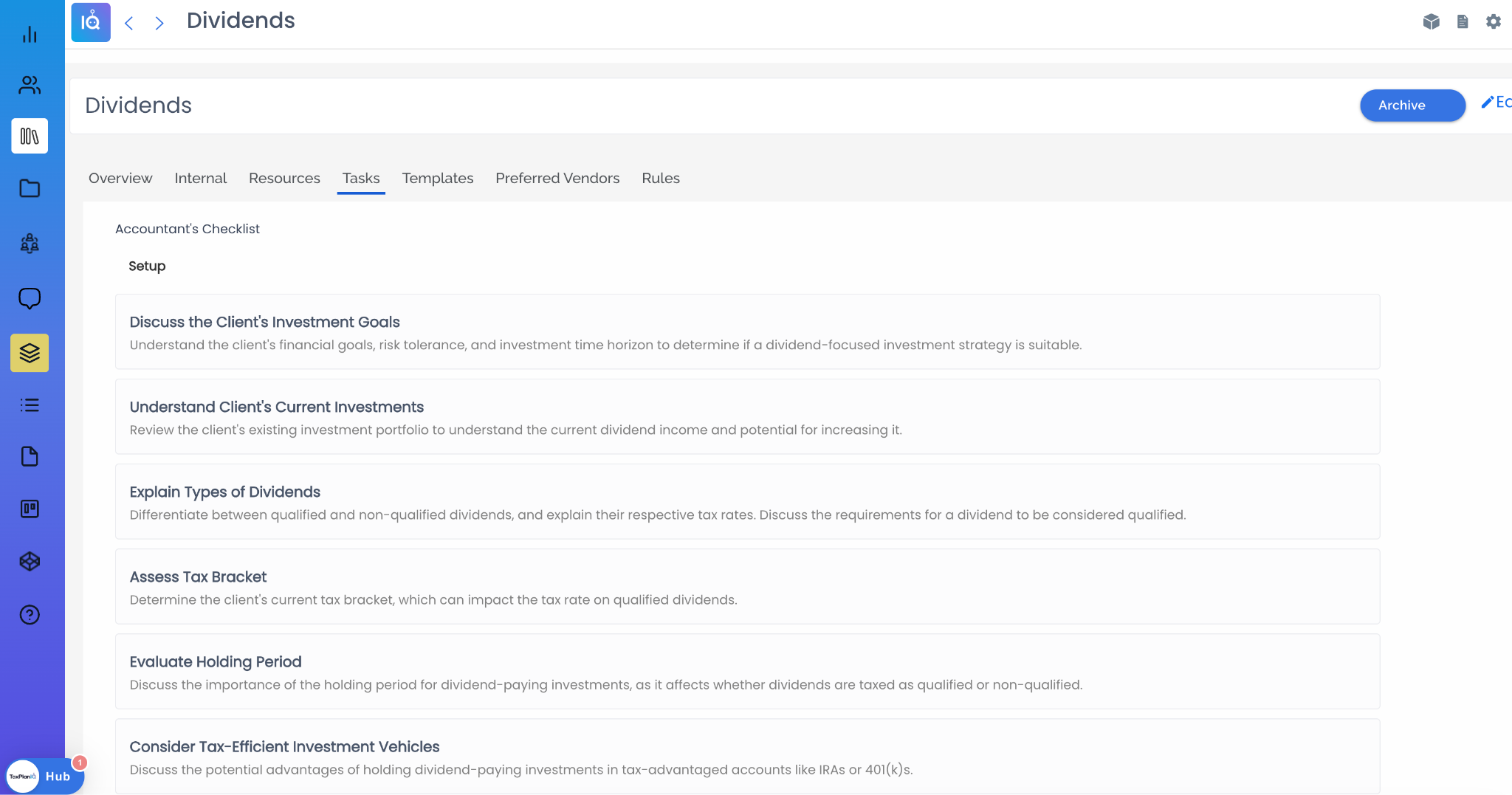
TaxPlanIQ has over 130 advanced tax strategies, including dealing with dividends.
To qualify for lower capital gains tax rates, clients generally must hold dividend-paying common stock for more than 60 days during the 121-day period beginning 60 days before the ex-dividend date. This is especially relevant for SCHD stock holders and other high-yield dividend investors.
Clients investing in dividend reinvestment plans (DRIPs) should:
To reduce tax liability, clients can:
Tax professionals should integrate these strategies into year-end planning discussions to help clients reduce taxable income.
Tax professionals should also maintain separate regular-tax and AMT basis records for ISO shares because the two basis amounts may differ after an ISO exercise.
By identifying these common pitfalls, tax professionals can help clients avoid costly mistakes and stay compliant with IRS rules.
For clients with international investments, foreign dividends add another layer of complexity to 1040 tax form filings. Investors who own foreign stocks, ETFs, or mutual funds may receive foreign-source dividends, which have unique tax implications.
Foreign dividends are generally included in taxable income in the same manner as U.S. dividends. However, a foreign dividend qualifies for the lower qualified-dividend tax rates only if the payer and the dividend satisfy the applicable qualified-foreign-corporation, holding-period, and related IRS requirements.
They often come with an additional tax consideration:
Important Tip: Depending on the location, value, and manner in which foreign assets are held, clients may have additional reporting obligations, including Form 8938 and the separate Foreign Bank and Financial Accounts Report, commonly called the FBAR. These requirements have different thresholds and should be evaluated separately.
Understanding foreign dividend taxation helps prevent double taxation issues and maximizes available tax credits.
With IRS regulations evolving, tax professionals must stay ahead of new tax reporting requirements and planning opportunities.
Tax professionals should also confirm final 2026 forms and instructions before filing because the IRS can revise draft forms before the filing season begins.
By staying informed and leveraging tax planning tools, professionals can ensure clients optimize tax strategies for years to come.
With complex tax rules surrounding dividends, stock incentives, and the 1040 tax form, TaxPlanIQ simplifies tax planning by:
Want to optimize dividend and stock incentive tax planning? Sign up for a free demo of TaxPlanIQ today!
.png?width=350&height=350&name=Top%205%20Tax%20Planning%20Discovery%20Questions%20Mockup%20(1).png)

Interviews, tips, guides, industry best practices, and news.
Quick Answer Summary For a solo accountant taking on a first paid tax planning engagement, the best software is one that...
Read MoreTax planning as an RIA service Adding tax planning to an RIA means adding a forward-looking service that reviews a clien...
Read MoreQuick Answer Summary TaxPlanIQ is tax planning software that turns a client's 1040 into a client-ready proposal showing ...
Read MoreThe best tax projection software options for most firms in the United States are softwares that answer client questions....
Read MoreQuick Answer Summary To build a tax plan for an S corp owner, set a defensible reasonable salary first, then stack three...
Read More
.png?width=800&name=Blog%20Header-%20Which%20Software%20Shows%20Clients%20How%20Much%20Tax%20They%20Could%20Save%20(1).png)