


Tax Planning Software for Solo Accountants
Quick Answer Summary For a solo accountant taking on a first paid tax planning engagement, the best software is one that...
Read MoreEvery spring you finish a client’s return, explain what they owe, and move on to the next one. But the most value you can give to a client comes after the filing work is done.
The return gives you a place to start. The next step is connecting what it shows with what the client can still do. A good 1040 tax planning review helps you find those opportunities, evaluate them, and give the client a few clear decisions. TaxPlanIQ can help with the research, modeling, and presentation along the way.
Firms usually start with the client’s most recently filed return and any supporting documents they have alongside the return. A typical review will look at…
Then they ask what has changed. Next, they update the numbers, evaluate possible strategies, and estimate their tax impact before recommending anything.
The main problem is this:
Doing all of this manually means pulling information from different forms, researching requirements, running calculations, and assembling the findings for the client. And the work becomes much harder to repeat when you’re reviewing dozens and dozens of returns. Many firms give up on the idea because it’s too time demanding.
Thankfully, software helps now with those steps!

Download Here How to Turn 10 of Your Current Tax Return Clients Into Tax Advisory Engagements Before April 15
(Delivered to your inbox, free!)
Here are a few areas that often give you a useful starting point:
|
Area |
What to review |
What to ask |
|
Retirement contributions |
W-2 contribution details and self-employed retirement deductions |
Is there unused contribution room? Would a different plan fit the business? |
|
Business income |
Schedule C profit, K-1 income, and owner compensation |
Have profits or the owner’s responsibilities changed enough to justify an entity review? |
|
Deductions and charitable giving |
Standard versus itemized deductions and giving patterns |
Would a different timing or funding approach help the client meet their goals? |
|
Investment gains and losses |
Schedule D, distributions, and loss carryovers |
Are upcoming transactions worth coordinating with the client’s investment professional? |
|
Tax payments |
Withholding, estimated payments, and any underpayment penalty |
Does the payment schedule still fit the client’s income? |
These are simply general signals to investigate. A blank retirement deduction doesn’t establish that the client missed an opportunity because contributions may appear elsewhere, or eligibility and cash flow may limit what they can do. Likewise, while a profitable Schedule C is a reason to compare business structures, it isn’t enough to recommend an S corporation without considering other factors like compensation, state taxes, retirement contributions, and ongoing costs.
The real value comes from following the signal far enough to determine whether it matters for this particular client.
TaxPlanIQ reads uploaded 1040s & suggests strategies from its library of 130+ advanced tax planning strategies. Bulk uploads of up to 100 returns can help you begin reviewing opportunities across your client list quickly.
That gives you a starting point instead of researching every possible strategy from scratch. You can examine the suggestions the software gives rather than having to start from nothing. This is a massive time saver, don’t under estimate how big of a deal this can be to help your firm!
Telling a client, “Look into the Augusta Rule” gives them something to think about. However, most clients don’t want to be given something to think about. They want you to educate them, not for themselves to have a research project on their hands. That’s why firms should give a recommendation with a contribution amount, estimated tax impact, and deadline. It gives a client something to decide, not something to “think about”.
Firms can build a current-year projection using software and compare the strategies you’re considering. With TaxPlanIQ Projections, you can model federal and state tax, compare up to 5 scenarios side by side, and evaluate an S corporation election against the client’s current structure.
Keep the explanation straightforward:
The Augusta Rule produces a permanent reduction. The business deducts the rent, and the owner excludes it from income as long as the home is rented for fewer than 15 days in the year. The tradeoff is documentation: a market-rate comparable, a written agreement, and minutes for every meeting. That belongs in the conversation alongside the dollar figure.
You may review several possibilities. Your firm can always lead with two or three findings that offer meaningful value or need a timely decision. Explain each one in terms of the client’s situation. A useful format might look this this:
If you ruled out an idea the client asked about, explain that as well. Showing why an entity change would add more cost than benefit demonstrates that you evaluated the question. Once the scope and estimated value are clear, discuss the planning fee.
Then leave the client with a short written action list: the recommendation, estimated impact, deadline, and person responsible. TaxPlanIQ’s reports can carry your firm’s branding and help you present the findings in a format the client can revisit.
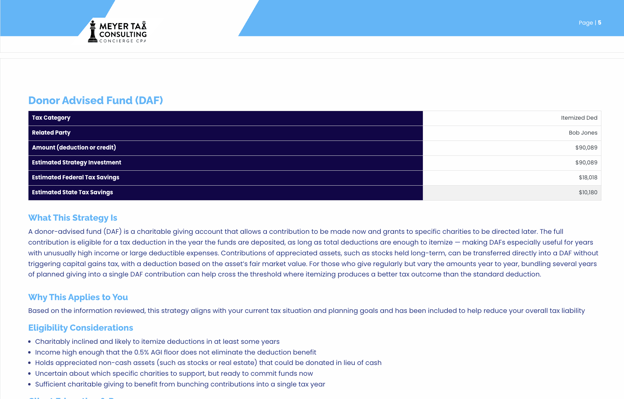
TaxPlanIQ gives a ready-to-send report discussing each tax strategy in depth that a client can take advantage of.
You don’t need to launch tax planning across your entire firm at once. Choose a small group of clients whose returns raise worthwhile questions. Review the opportunities, confirm their current circumstances, and bring them a focused set of recommendations.
That is how a completed return becomes the beginning of another conversation. TaxPlanIQ helps you organize the work from identifying strategies through modeling outcomes and preparing the client presentation. Your judgment connects those findings to decisions the client can act on! See how it works by taking a free demo here.

Interviews, tips, guides, industry best practices, and news.
Quick Answer Summary For a solo accountant taking on a first paid tax planning engagement, the best software is one that...
Read MoreTax planning as an RIA service Adding tax planning to an RIA means adding a forward-looking service that reviews a clien...
Read MoreQuick Answer Summary TaxPlanIQ is tax planning software that turns a client's 1040 into a client-ready proposal showing ...
Read MoreThe best tax projection software options for most firms in the United States are softwares that answer client questions....
Read MoreQuick Answer Summary To build a tax plan for an S corp owner, set a defensible reasonable salary first, then stack three...
Read More