.png?width=357&height=85&name=tpiq-logo%20(375x85).png "TaxPlanIQ")


.png?width=800&name=Blog%20Header-%20Tax%20Filing%20Deadline%202026%20What%20Every%20Tax%20Professional%20Needs%20to%20Know%20(1).png)
Tax Planning Software for Solo Accountants
Quick Answer Summary For a solo accountant taking on a first paid tax planning engagement, the best software is one that...
Read MoreFirst, let’s give a quick preface. Not every S corp client needs a full plan. The owner worth your time usually looks like this:
That last set of signals is the fastest screen you have. Three blank lines on a return with $300,000 of flow-through income is a client who's paying more than they should.
Dana is 52 and owns a digital marketing agency in Texas, which keeps this example federal-only. Here's her setup going into 2026:
|
Item |
Current setup |
|
Entity |
S corp since 2021, Dana owns 100% |
|
Revenue |
$1.1 million |
|
Team |
Six regular 1099 contractors, no W-2 employees besides Dana |
|
Profit before owner pay |
$380,000 |
|
Dana's W-2 salary |
$60,000 |
|
Filing status |
Married filing jointly, spouse has no earned income, children are grown |
|
Health insurance |
Family HSA-qualified high-deductible plan, $24,000 a year, paid from her personal account |
|
HSA |
Open, never funded |
|
Retirement plan |
None |
|
Home office |
300 square feet of a 2,500-square-foot house, not reimbursed |
|
Vehicle |
Personal car, about 9,000 business miles a year, not reimbursed |
|
Equipment and phone |
$3,500 of laptop and monitors plus $1,800 of business phone and internet, paid personally |
If nothing changes, Dana's 2026 federal income tax plus total FICA on her salary comes to $61,607. That number looks fine until we look closer:
.png?width=350&height=350&name=The%20Accountants%2012-Month%20Tax%20Planning%20Calendar%20Mockup%20(1).png)
Download the Accountant’s 12-Month Tax Planning Calendar
The tax code never gives you a salary number. It gives you a rule: an S corp has to pay a shareholder-employee reasonable compensation before it pays out distributions. If the salary is too low, the IRS can reclassify distributions as wages.
The IRS lists the factors it looks at on its S corporation compensation and medical insurance issues page:
The case that shows what happens when the salary is too low is David E. Watson, P.C. v. United States. Watson, an accountant, ran his practice through an S corp and paid himself $24,000 a year in 2002 and 2003. In those same years, he took profit distributions of $203,651 and $175,470. The government's expert valued his work at $91,044 a year. The district court agreed, and the Eighth Circuit upheld it.
You don't have to build this number by hand. Use a service like RCReports to produce a reasonable compensation report for each S corp client:
Keep the report in the client file and rerun it every year. If the IRS questions the salary, you hand over a documented analysis.
You'll hear about the "60/40 rule" (60% salary, 40% distributions). It isn't in the tax code or the regulations, and it won't hold up if the IRS audits the return.
The plan sets Dana's salary at $140,000, backed by RCReports and a corporate resolution setting the salary.
Every dollar of W-2 pay does three things at once:
The table below runs Dana's full plan from Steps 3 through 5 at six salary levels. Every row includes the same health, HSA, accountable plan, and solo 401(k) treatment.
|
W-2 salary |
K-1 income |
QBI deduction |
Total FICA |
Federal income tax |
Income tax + FICA |
401(k) contributions |
|
$60,000 |
$259,868 |
$47,174 |
$9,180 |
$33,258 |
$42,438 |
$47,500 |
|
$100,000 |
$206,808 |
$36,562 |
$15,300 |
$32,719 |
$48,019 |
$57,500 |
|
$120,000 |
$180,278 |
$31,256 |
$18,360 |
$32,450 |
$50,810 |
$62,500 |
|
$140,000 |
$153,748 |
$25,950 |
$21,420 |
$32,181 |
$53,601 |
$67,500 |
|
$160,000 |
$127,218 |
$20,644 |
$24,480 |
$31,911 |
$56,391 |
$72,500 |
|
$190,000 |
$87,423 |
$12,685 |
$29,070 |
$31,507 |
$60,577 |
$80,000 |
Every extra $20,000 of salary adds about $2,791 to Dana's federal tax bill. It also lets her put another $5,000 into her 401(k).
On paper, the $60,000 salary looks like the winner, at $11,163 cheaper than paying her $140,000. It's also the number most likely to get the IRS's attention. Say the IRS decided $80,000 of her distributions should have been salary. She'd owe about $12,240 a year in extra payroll tax, plus penalties and interest, for every year the IRS can still review.
At $140,000, Dana still takes $153,748 out of the business as distributions, with no payroll tax on that money. And it's a salary she can back up with her time log and the market data.
2026 timing matters. Dana has been paid at a $60,000 pace this year, about $5,000 a month, so she's received about $45,000 through September. To reach $140,000 for 2026, she needs about $95,000 more in salary from October through December, roughly $31,700 a month. The IRS looks at the full-year total, so a fourth-quarter catch-up still counts.
The bigger paychecks help in a second way. Quarterly estimated payments count on the day they're paid, but the IRS treats tax withheld from wages as if it had been paid evenly across the whole year, even when most of it comes out in December (§6654(g)). If Dana shorted her estimates earlier in 2026, the extra withholding from her fourth-quarter paychecks can cover the gap and reduce or erase the underpayment penalty.
Inside the S Corp, Dana is an employee of her own corporation, and her unreimbursed employee business expenses simply aren't deductible. The One Big Beautiful Bill Act from 2025 made the loss of miscellaneous itemized deductions permanent. An accountable plan under Treas. Reg. §1.62-2 is the route here: the S corp reimburses Dana, deducts the reimbursement, and the payment stays off her W-2.
The plan should meet 3 tests: a business connection, substantiation within a reasonable period, and return of any excess. Under the fixed-date safe harbor, that means there has to be substantiating within 60 days and returning excess within 120 days.
Dana's 2026 reimbursements:
|
Item |
Basis |
2026 amount |
|
Home office |
12% of $38,000 in home costs (mortgage interest, property tax, insurance, utilities, repairs) |
$4,560.00 |
|
Vehicle, January to June |
4,500 miles at 72.5 cents |
$3,262.50 |
|
Vehicle, July to December |
4,500 miles at 76 cents |
$3,420.00 |
|
Laptop and monitors |
Receipts |
$3,500.00 |
|
Phone and internet |
Business-use share |
$1,800.00 |
|
Total |
$16,542.50 |
Two 2026 details to get right:
For future equipment, the S corp can buy it directly. For 2026, §179 allows up to $2,560,000 of expensing, and 100% bonus depreciation is back for property acquired after January 19, 2025.
For an S corp owner, retirement contributions run off W-2 wages only. Distributions don't count.
Here's how the three options compare for Dana at a $140,000 salary:
|
Solo 401(k) |
SEP IRA |
Defined benefit or cash balance |
|
|
Employee deferral |
$24,500 + $8,000 catch-up (age 50+) |
None |
Can pair with a 401(k) |
|
Employer contribution |
25% of W-2 pay: $35,000 |
25% of W-2 pay: $35,000 |
Set by an actuary |
|
Dana's 2026 total |
$67,500 |
$35,000 |
Varies by age, pay, and design |
|
Annual cap |
$72,000 plus catch-up |
$72,000 |
$290,000 annual benefit limit |
|
Set-up deadline |
Before year-end, with deferral elections before wages are paid |
Extended return due date |
Varies; talk to the actuary early |
|
Eligibility catch |
No common-law employees other than a spouse |
Must cover eligible employees at the same percentage |
Must cover eligible employees; annual funding obligation |
Solo 401(k) wins for Dana. In the full plan, it saves $7,459 more in federal tax than a SEP and shelters $32,500 more. The deferral piece is what the SEP can't match. Dana's 2025 FICA wages were under $150,000, so under the SECURE 2.0 Roth catch-up rule her 2026 catch-up can go in pre-tax.
The deadlines for the solo 401(k):
One condition can break this strategy: the contractors have to be real contractors. If any of the six should be W-2 employees, the solo 401(k) isn't available and you're designing a plan that covers staff.
SEP wins in three cases:
Defined benefit or cash balance wins for owners 50 and older with steady profits who want to shelter well past $72,000 a year and can commit to annual funding. Pairing one with a 401(k) brings in the §404(a)(7) combined deduction limit, which usually caps the profit-sharing contribution at 6% of pay. Elective deferrals don't count against it. Get the actuary's illustration before you promise a number.
Dana doesn't get one in 2026. The §415(b) limit caps her annual benefit at 100% of her highest three-year average compensation, and her $60,000 salary years drag that average down. A cash balance plan belongs on the table for 2027 or 2028, once the $140,000 salary is on record and her profit holds.
If you own more than 2% of an S corp, the IRS treats you like a partner when it comes to fringe benefits. The S corp can't give Dana tax-free health coverage the way it could for a regular employee. And since Dana pays her $24,000 premium out of her own pocket, she gets no deduction for it at all.
Health insurance. The fix comes from Notice 2008-1, and it takes two steps:
Dana loses the deduction for any month she or her spouse could get subsidized coverage through an employer. Neither can, so she gets the full deduction.
There's one catch. The Form 8995 instructions say the self-employed health insurance deduction reduces QBI. The premium already cut Dana's S corp profit when the business paid it, so it ends up reducing QBI twice. For Dana that second cut costs $1,152 in 2026. Build it into the plan so the client isn't surprised by it later.
HSA. A more-than-2% shareholder can't make pre-tax HSA contributions through a cafeteria plan. That leaves two routes:
For Dana, personal funding is better. Her salary is already set by the reasonable compensation analysis, so an S corp contribution doesn't replace any wages. It just shrinks her K-1 and her QBI deduction. Funding the $8,750 family maximum personally, out of distributions, saves her $385 more than routing it through the S corp. The FICA angle only pays off when the HSA contribution would otherwise have been salary.
The 2026 family limit is 8,750(4,400 self-only), plus $1,000 at 55. Dana has until April 15, 2027 to fund it.
Here's the full 2026 federal picture, built one strategy at a time.
|
Stage |
Federal income tax + FICA |
Change |
|
A. Current setup ($60,000 salary, nothing else) |
$61,607 |
|
|
B. Salary raised to $140,000, nothing else |
$76,512 |
+$14,905 |
|
C. Health insurance through the S corp |
$73,056 |
−$3,456 |
|
D. HSA funded personally ($8,750) |
$70,956 |
−$2,100 |
|
E. Accountable plan ($16,542.50) |
$67,780 |
−$3,176 |
|
F. Solo 401(k) ($67,500) |
$53,601 |
−$14,179 |
Here's how to read the table:
Show the client all four. The $8,006 on its own makes the plan look small, and the $22,911 on its own overstates what changes in her bank account.
A client in a state with an income tax needs the state layer modeled on top, including any pass-through entity tax election.
For each piece of Dana's plan:
Dana doesn't need your spreadsheet. She needs a quick one-page summary of what she can save and what the investment would be.
Price it with the ROI Method of Value Pricing. The client should see at least a 200% return on what they pay you. Set a fixed fee up front that takes into account the CURB framework:
A fixed annual fee of $7,500 can give Dana a projected 205% return on the first-year savings alone. Price against the $22,911, and explain to Dana why that's the right comparison: her real alternative is the $60,000 salary plus the exposure.
When you're comparing options, check whether the software can:
TaxPlanIQ's Projections module covers most of that list:
Beyond Projections, TaxPlanIQ includes a library of 130+ advanced tax planning strategies. The ROI Method of Value Pricing is the pricing framework TaxPlanIQ teaches firms for engagements like Dana's.
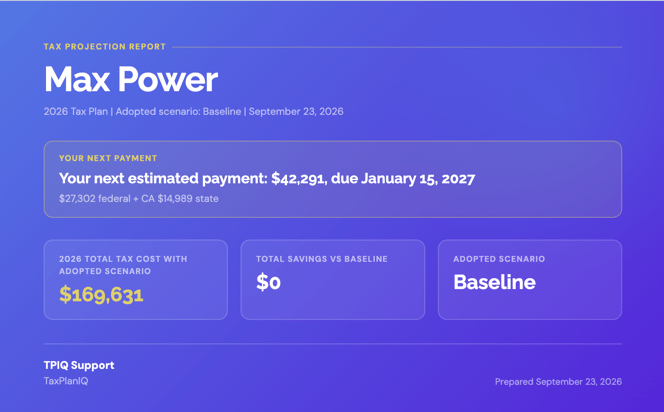
TaxPlanIQ Projections include entity comparisons and scenario modeling.

Interviews, tips, guides, industry best practices, and news.
Quick Answer Summary For a solo accountant taking on a first paid tax planning engagement, the best software is one that...
Read MoreTax planning as an RIA service Adding tax planning to an RIA means adding a forward-looking service that reviews a clien...
Read MoreQuick Answer Summary TaxPlanIQ is tax planning software that turns a client's 1040 into a client-ready proposal showing ...
Read MoreThe best tax projection software options for most firms in the United States are softwares that answer client questions....
Read MoreThe best software for finding tax savings strategies for high-income clients is TaxPlanIQ. It reads the client's actual ...
Read More
.png?width=800&name=Blog%20Header-%20Which%20Software%20Shows%20Clients%20How%20Much%20Tax%20They%20Could%20Save%20(1).png)