


Tax Planning Software or AI Chatbots: Why Claude or ChatGPT Can't Replace Purpose-Built Tax Planning Tools
Quick Answer Summary Can ChatGPT or Claude Replace Tax Planning Software? No. ChatGPT and Claude are useful for explaini...
Read MoreYour business-owner clients likely already ask you about taxes. They ask before a big distribution, after a strong year, and every time they think about selling the company. Most advisors answer with some version of "talk to your accountant," and the conversation ends there.
But that answer costs you…and that doesn’t mean you should prepare the return. It means there may be room for you to help the client think through the decision before it’s made, then coordinate with the accountant who handles the filing. This is the main role of a financial advisor when it comes to tax planning: help clients understand the tax impact of decisions that are still ahead.
Tax preparation reports what already happened; Tax planning looks at what the client could do next.
That might mean comparing an entity change, modeling a Roth conversion, considering the timing of a large charitable gift, or reviewing the tax impact of a business sale. The advisor helps evaluate the decision while the accountant can handle the return and filing.
This is why you don’t need to prepare returns to help a client plan. Preparing federal returns for pay requires an IRS Preparer Tax Identification Number, and paid preparers can face penalties under IRC §6694 for certain understatements on returns they prepare. Tax planning is a different kind of work, though your firm’s compliance policy may set limits on the advice you can provide.
There’s interest in adding the service. In Financial Planning’s Financial Advisor Confidence Outlook survey, 29% of advisors said they provide tax planning themselves. Of those who don’t, 44% said they were considering adding it. So, many advisors see the opportunity. The question is how to offer the service while keeping return preparation with the client’s accountant.
Business owners make decisions that can affect their personal tax bills throughout the year, such as how the business is structured, how the owner is paid, which retirement plan the company sponsors, when equipment is purchased, and how an eventual sale is arranged.
Entity structure is a common first conversation with business-owner clients that many advisors have. TaxPlanIQ Projections can model things such as the Schedule C version of a client next to an S-Corp version. Having access to projections, scenario modeling, and entity comparisons is extremely valuable for many financial advisors. Even if an advisor doesn’t have a ton of business owner clients, having the ability to model scenarios comes in handy for many high-net-worth families and high earners.
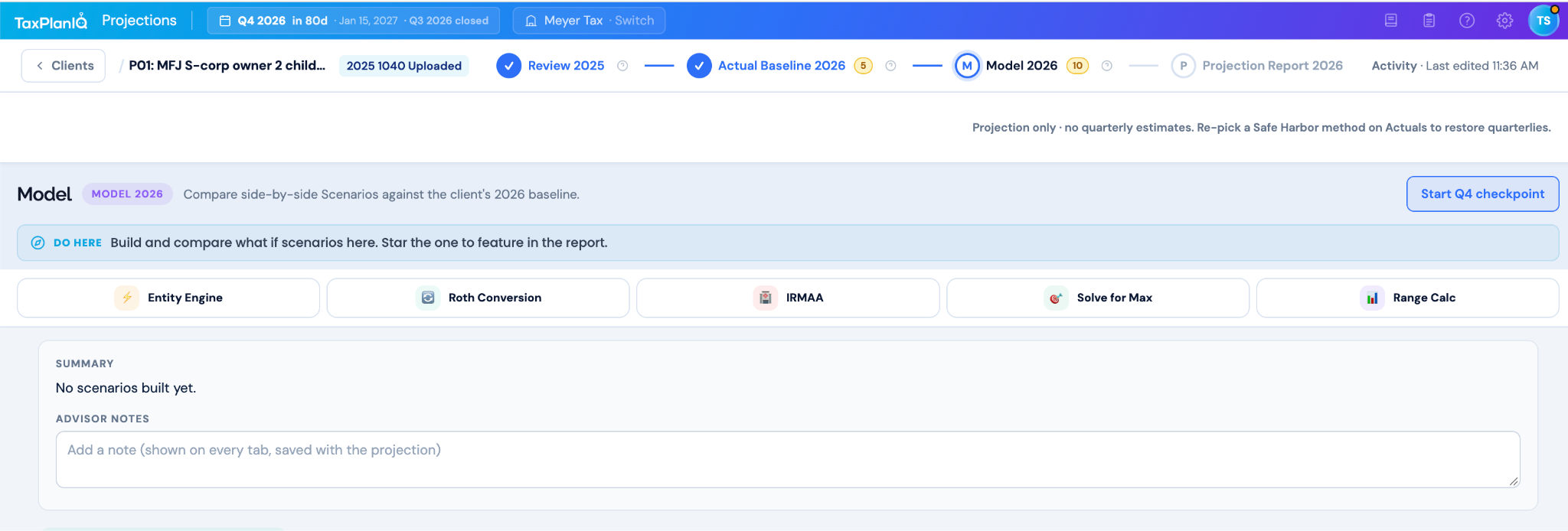
With TaxPlanIQ financial advisors can do scenario modeling for any client, including features such as entity comparisons, Roth conversions, IRMAA, Solve for Max, and Range Calc
Other common planning conversations with business owners may include:
Again, you don’t need to prepare the return to start these conversations. You need the return the accountant filed, a clear understanding of the client’s goals, and a process for evaluating what could change.
High-net-worth clients also face decisions with tax consequences, often tied to investments, charitable giving, or a planned sale.
For example, many financial advisors can help a client evaluate:
These are decisions to evaluate before the client acts. As the advisor who understands the client’s portfolio and broader financial picture, you may be well placed to identify the question. The accountant can review the details and advise on reporting.
One advisor, Ron Joseph, put it this way: “When you show people how to keep the money they’re already making, they’re way more open to talking about how to grow or protect it.”
TaxPlanIQ helps advisors review a client’s tax information, evaluate potential strategies, and prepare a plan to discuss with the client. The workflow looks like this:
Upload the client’s 1040.
Review strategy recommendations.
Compare scenarios with projections.
Build and present a tax plan.
Share the plan with the accountant.
 Get our free download: A Financial Advisor's Guide to Serving Freelancers, Contractors, and 1099 Workers
Some platforms charge more as you add households. That can make advisors think twice before running a plan for a smaller client or prospect.
TaxPlanIQ charges a flat monthly rate, with no per-household or per-client fees. You can see the plan details on the TaxPlanIQ pricing page.
Flat-rate pricing gives you room to decide which clients could benefit from a plan without calculating an extra software charge for each household. You can also run a plan for a prospect before they become a client, if that fits your firm’s process.
A plan is more likely to be useful when the accountant can review it too. The client’s accountant can understand what you’re recommending and have a chance to weigh in on the tax details.
A well-organized handoff can make the plan easier for the accountant to review and can support a stronger working relationship. Ron Joseph of Elite Consulting Services, a TaxPlanIQ user, says his accountant partner began referring other clients to him after they worked together on plans. If you’re curious about how it works, take a demo here.

Interviews, tips, guides, industry best practices, and news.
Quick Answer Summary Can ChatGPT or Claude Replace Tax Planning Software? No. ChatGPT and Claude are useful for explaini...
Read MoreQuick Answer Summary Start with the client’s most recently filed 1040 to identify potential planning opportunities. Conf...
Read MoreQuick Answer Summary For a solo accountant taking on a first paid tax planning engagement, the best software is one that...
Read MoreTax planning as an RIA service Adding tax planning to an RIA means adding a forward-looking service that reviews a clien...
Read MoreQuick Answer Summary TaxPlanIQ is tax planning software that turns a client's 1040 into a client-ready proposal showing ...
Read More